
On this page
What is different about commercial gutters
A commercial roof often has one large plane draining to one edge. A 100-foot metal roof sheds water much faster than a shingled house roof of similar area, and every gallon goes to a single run of gutter. That calls for:
- Bigger profiles. 6-inch K-style is a minimum on many buildings; box gutters suit larger ones.
- Bigger downspouts. 3x4-inch, 4x5-inch or round equivalents, and more of them.
- Heavier gauge. Long runs and ladders against the gutter need stiffer metal.
- Expansion joints. Long runs move with heat, so expansion joints are fitted at intervals.
Building types
| Building | Typical needs |
|---|---|
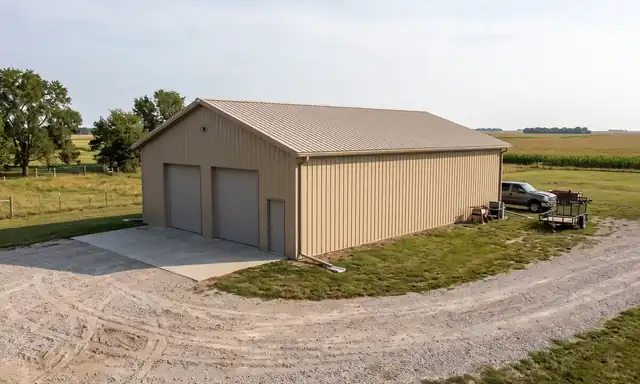
| Metal shops and warehouses | Box gutters, large downspouts, heavy brackets |
| Strip retail and offices | Gutters that suit the façade, downspouts away from walkways |
| Churches | Tall eaves, steep roofs, sometimes copper or half-round on older buildings |
| Apartments and rentals | Durable systems, guards where trees overhang, easy access |
| Beach rentals | Salt-resistant materials, wind fastening, minimal upkeep between seasons |
Wind and salt
Commercial buildings near the waterfront face the same conditions as houses, at a bigger scale. The NWS climate overview records 73 tropical cyclones bringing gusts of 39 mph or more to Wilmington between 1871 and 2021. Long, exposed gutter runs on metal buildings need strong brackets at close spacing. Near salt water, the American Galvanizers Association advises extra evaluation for galvanized steel within 250 feet of the coast, which pushes many waterfront projects toward aluminum.
Drainage and stormwater
Commercial sites usually have engineered stormwater systems. Downspouts may connect to underground pipe, swales or retention ponds that were part of the site's permit. Changing where roof water goes can affect that system, so check with the property manager or engineer before moving outlets. Properties inside city limits can reach Wilmington Stormwater Services; outside the city, the page lists New Hanover County's number.
Licensing
North Carolina requires a general contractor license from the NC Licensing Board for General Contractors for projects costing $40,000 or more. Large commercial gutter projects can cross that line. Ask for the license number and check it.
Box gutters and built-in gutters
Some older commercial and institutional buildings, and many historic churches, have built-in or box gutters set into the roof edge or cornice. These are lined with metal or membrane, and when the lining fails, water goes straight into the building. Repairing or relining them is specialist work. In Wilmington's local historic districts, the city's review table lists roofing over built-in gutters as an item needing review, so check before choosing a fix that covers them.
Maintenance plans
Commercial property managers often prefer a schedule: cleaning and inspection twice a year, plus a check after named storms. With pines and oaks around many local properties, spring and late fall visits catch the heaviest debris. Ask whether the contractor reports problems with photos so you have a record.
Safety and access
Commercial gutter work often needs lifts rather than ladders, traffic control in parking lots, and coordination with tenants. Make sure the contractor's insurance covers the work and that they have a plan for keeping walkways safe while they work.
Water at entrances
The most common complaint on commercial buildings is water falling at a door or walkway. Usually a downspout ends too close to the entrance or a gutter overflows at a valley above it. Re-routing a downspout or adding one at the valley often fixes it for far less than replacing the whole system.
Commercial gutter questions
What is a box gutter?
A rectangular gutter, larger than residential K-style, used on commercial and metal buildings. It may be hung on the eave or built into the roof edge, and pairs with large rectangular downspouts.
What gauge is used on commercial gutters?
Heavier than residential: thicker aluminum, galvanized or galvalume steel, depending on size, exposure and budget. Long, wide gutters need stiffness to stay straight.
How are expansion joints used?
On long runs, metal expands and contracts with temperature. Expansion joints, or outlets placed to break long runs, let the gutter move without tearing at joints or fasteners.
Commercial building types and gutter choices
| Building | Profile | Downspouts |
|---|---|---|
| Metal warehouse | Box gutter | 4x5 or larger |
| Strip retail | K-style or box | Away from entrances |
| Church | Half-round or K-style, sometimes copper | Round or rectangular |
| Apartment block | 6-inch K-style | 3x4 with guards |
| Office | Fascia-style or box | Concealed or matched |
What to ask
- What gutter and downspout sizes do you propose for this roof area?
- What gauge and bracket spacing?
- How will you handle expansion on long runs?
- Where will each downspout discharge?
- Can you work around our opening hours?
- What insurance do you carry, and can we be named on the certificate?