
On this page
What gutter installation involves
A gutter system has three jobs: catch roof water, carry it to the corners, and put it on the ground far enough from the house that it does not come back. Installation covers all three. The gutter itself is formed on site from a coil of aluminum by a machine on the installer's trailer, so each run is one piece from corner to corner. The only joints are at the corners, the end caps and the downspout outlets.
The usual steps are the same on almost every house:
- Take down the old system and haul it away, if there is one.
- Check the fascia. Soft or rotted boards are replaced before anything is fastened to them. See fascia and soffit repair.
- Plan outlets and slope. Downspouts go where the ground can take the water, and each run is pitched toward them.
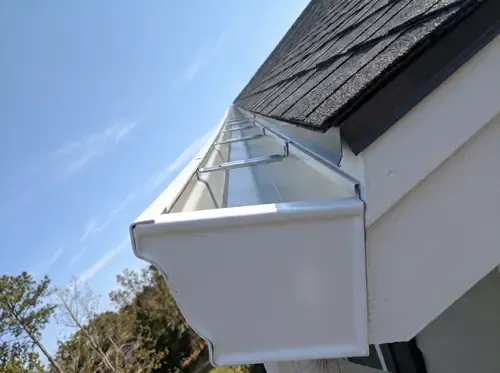
- Form and hang the gutters on hidden hangers screwed into the fascia.
- Seal corners and end caps, then fit downspouts and extensions.
- Run water through it to prove it drains.
Sizing for coastal rain
Wilmington averages 57.61 inches of rain a year, according to the National Weather Service. Averages hide the problem, though. In 2018 the city recorded 102.40 inches, and Hurricane Florence alone dropped 23.02 inches at the airport over four days. What overwhelms gutters is the hour when rain falls faster than the trough and downspouts can move it.
That is why sizing matters here:
| Choice | Typical use |
|---|---|
| 5-inch K-style, 2x3 downspouts | Smaller single-story roofs with plenty of downspouts |
| 5-inch K-style, 3x4 downspouts | Same gutter, faster draining, fewer clogs |
| 6-inch K-style, 3x4 downspouts | Large or steep roofs, two-story homes, valleys, long runs |
| Half-round, round downspouts | Older and historic houses where the look matters |
Many newer homes in Leland, Porters Neck and Murraysville have big roof planes that 5-inch gutters struggle with. See 6-inch gutters and the 5-inch vs 6-inch guide.
Fastening for wind
Wind gets under a gutter at the ends and corners and levers it off. Wilmington has recorded a 105 mph gust in Florence and its all-time record of 135 mph in Hurricane Helene in 1958, according to the National Weather Service. Gutters cannot be built to survive anything, but the way they are hung makes a real difference:
- Hidden hangers screwed into the fascia, not spikes driven through the face
- Close hanger spacing, with extra hangers near corners and ends
- Screws long enough to reach solid wood, in corrosion-resistant material
- Downspouts strapped to the wall at each section
Materials near salt water
Aluminum is the usual choice on this coast because it does not rust. Galvanized steel is stronger, but its zinc coating wears faster in warm, salty air; the American Galvanizers Association treats sites within 250 feet of the coast as needing extra evaluation. Copper lasts for decades and suits some historic homes, at several times the price. See aluminum gutters, copper gutters and gutters in salt air.
Historic homes
Wilmington has a large stock of older houses. About 8.9% of the city's homes were built before 1940, according to Census figures compiled by Point2. In the city's local historic districts, exterior changes may need a Certificate of Appropriateness, and the city's review table lists gutter and downspout installation, with separate entries depending on whether the color matches the trim and whether gutters would obscure architectural detail. Half-round gutters often suit these houses.
Types of installation
- Seamless gutters: one-piece runs formed on site
- 6-inch gutters: more capacity for big roofs
- Half-round gutters: the period profile
- Copper gutters: long-lived and distinctive
- Aluminum gutters: the coastal default
- Downspouts: sizing, placement and drainage
Gutter installation questions
What is included in a gutter installation?
A complete installation covers removing any old gutters, checking and repairing the fascia, forming seamless runs on site, hanging them on hidden hangers with the correct slope, fitting and sealing corners and end caps, cutting outlets, installing downspouts with elbows, straps and extensions, and water-testing the result. Guards, buried drains and extra fascia work are often priced separately.
How long do new gutters last?
That depends on the metal, the exposure and the upkeep. Aluminum and copper last for decades with care; steel lasts as long as its coating does. On beach houses, salt and wind shorten every material's life, which is why stainless fasteners and heavier gauges are worth paying for there.
Can gutters be installed in any season?
Yes. Gutter work is not weather-sensitive in the way painting is, though crews avoid high winds and lightning. Many owners book in spring or late fall to have gutters ready before or after the June 1 to November 30 hurricane season that ReadyNC describes.
What does a gutter installation quote look like?
| Line item | What it should state |
|---|---|
| Gutter | Profile, size, material, gauge, color, total footage |
| Hangers | Type and spacing |
| Corners and end caps | Number, how sealed |
| Downspouts | Number, size, color, extensions |
| Removal | Old gutters taken away |
| Fascia | Included allowance or price per foot |
| Guards | If included, type and footage |
| Warranty | Workmanship terms in writing |
Gutter installation glossary
- Seamless gutter: a one-piece run formed on site
- K-style: the standard profile with a decorative front
- Half-round: a semicircular profile on brackets
- Gauge: metal thickness, such as 0.027 or 0.032 inch
- Hidden hanger: a clip-in bracket screwed into the fascia
- Drip edge: roof-edge flashing that feeds water into the gutter
- Outlet: the opening where the downspout attaches
- Miter: a corner joint
What to ask the contractor
- What size gutter and downspout, and why for this roof?
- What gauge of aluminum? (0.027 and 0.032 inch are common.)
- What hangers, how far apart, and what fasteners?
- Where will each downspout go, and where will that water end up?
- Is fascia repair included, or priced separately if found?
- What workmanship warranty do you give, in writing?
Cost
Gutters are priced by the foot. Material, size, height and the number of corners and downspouts move the figure. The calculator below uses national price ranges. Your contractor's written quote is the real number.
Rough price for your house
$1,440 to $2,240
A guide only, built from current national price ranges (Angi aluminum gutter cost guide, Angi seamless gutter cost guide, This Old House gutter installation cost guide). Corners, downspouts, fascia repairs and access change the figure. Call and a local contractor will measure and quote the real one.