
On this page
Common downspout problems
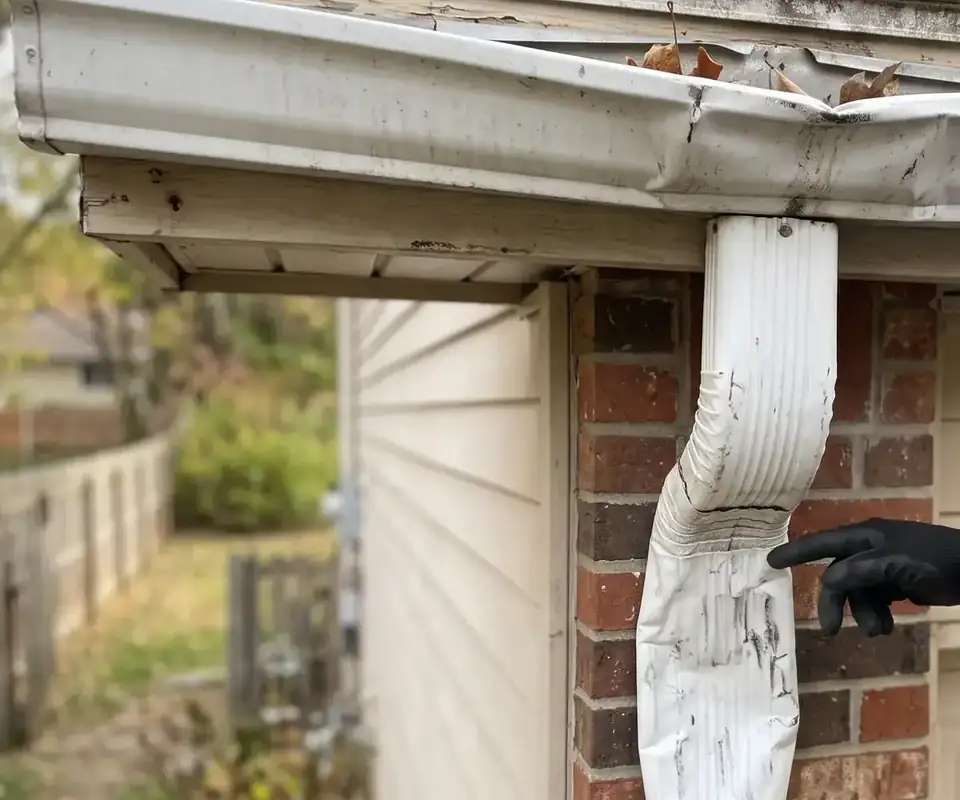
- Clogs at the outlet or the elbows, often pine needles, oak catkins and grit
- Loose sections where straps have rusted or screws pulled out
- Crushed bottoms from lawn mowers, cars or foot traffic
- Missing extensions so water dumps at the foundation
- Blocked underground drains full of debris and roots
- Lost downspouts after a storm
How they are fixed
- Clear the outlet and elbows; flush with a hose from the top.
- Replace crushed or split sections.
- Re-strap at every section and elbow with corrosion-resistant straps.
- Add or replace extensions and splash blocks.
- For buried lines, flush or snake them, or disconnect and discharge above ground.
Water by the foundation
Many local homes sit on crawl spaces. Water dumped at the foundation can pond under the house. On the sandy soils common around Wilmington, the simple fix of directing downspouts onto lawn works well; NC State Extension notes that sending downspouts onto vegetated areas instead of pavement can cut runoff volumes in half in sandy southeastern NC soils. See downspout drainage and your foundation.
Bigger downspouts
If a downspout keeps clogging, it may be too small for the debris load. Going from 2x3 to 3x4-inch makes a real difference under pines. Adding a gutter guard keeps most debris out of the downspout in the first place.
After a storm
Downspouts are often the first part lost in high wind. Check that each one is still attached, the elbows are intact and water reaches the extension. See hurricane and storm damage.
Clearing a clog
Most clogs sit at the top outlet or the first elbow. From a ladder, debris at the outlet can be pulled out by hand, then the downspout flushed with a hose from the top. If water backs up, the blockage is lower: taking the bottom elbow off often releases it. Persistent clogs at elbows suggest the downspout is too small or the gutter needs a guard.
Re-attaching loose downspouts
Downspouts should be strapped to the wall at each section and near each elbow, with corrosion-resistant straps and screws. Near the beaches, plain steel straps rust within a few seasons. Aluminum straps with stainless screws last far longer.
Extensions that stay put
Flexible and hinged extensions get kicked or mowed. A fixed extension of rigid downspout, or a concrete splash block set on a slight slope away from the house, is more reliable. The point is to put water on ground that slopes away and can soak it in.
Cost factors
- Number of downspouts involved
- Replacing sections vs whole downspouts
- Buried drain clearing or replacement
- Upsizing outlets and downspouts
Repair vs replace
Downspouts are inexpensive, so damaged sections are replaced rather than repaired. If every downspout on the house is small, loose and clogging, replacing them all with larger ones is a worthwhile upgrade on its own, even with the gutters left in place.
Downspout repair questions
How do I know where the clog is?
Run a hose into the gutter at the outlet. If water backs up in the gutter, the blockage is at the outlet or the first elbow. If water flows into the downspout but little comes out, it is lower, often at the bottom elbow or in a buried pipe.
Can I fix a downspout myself?
Clearing outlets and reattaching straps on a single-story house are simple jobs. Replacing sections, buried lines and work at height are better left to a contractor.
What is a downspout clean-out?
A removable section or fitting near the bottom of a downspout or at the start of a buried pipe that lets debris be cleared without digging.
Why do my downspouts gurgle?
Air and water are fighting past a partial blockage, often leaves or needles caught in an elbow. Clearing it restores smooth flow.
Downspout problems and fixes
| Problem | Fix |
|---|---|
| Clogged outlet | Clear, consider guard or larger outlet |
| Clogged elbow | Remove and clear, upsize if repeated |
| Loose from wall | New straps and screws |
| Crushed section | Replace section |
| Water at foundation | Add extension or splash block |
| Buried pipe blocked | Flush, snake or disconnect |
What to ask
- Is the blockage at the top, the elbows or underground?
- Would a larger downspout help here?
- Where should this downspout discharge?