
On this page
Brookwood at a glance
| Where | Between Carolina Place and Forest Hills, entered from Market St. (Port City Daily) |
| Built | Mainly the 1920s |
| Historic status | National Register historic district, listed December 2, 2014 (NC SHPO) |
| Size | 166 contributing buildings (Wikipedia) |
| Biggest gutter risks | Aging fascia, leaf and moss load, older downspout drains |
A 1920s neighborhood
Brookwood is a 1920s neighborhood between Carolina Place and Forest Hills. A brick column at Market Street and Brookwood Avenue marks its entrance, once marked by an arch, according to Port City Daily, which reported its addition to the National Register. The North Carolina State Historic Preservation Office lists the Brookwood Historic District as listed on December 2, 2014. The district has 166 contributing buildings, predominantly residential, with Colonial Revival among its styles.
With that listing, Port City Daily reported, Wilmington's National Register districts together included more than 7,000 historic buildings.
Houses about a century old
A house built in the 1920s has usually had its gutters replaced at least two or three times. Common findings on Brookwood-era houses:
- Fascia patched or painted over rot
- Gutters fastened with spikes that have worked loose
- Downspouts running into old buried clay or metal drains that no longer work
- Gutters undersized for roofs that now carry more debris from bigger trees
None of these are unusual, and all are fixable. A careful contractor checks the wood before quoting.
Profiles and looks
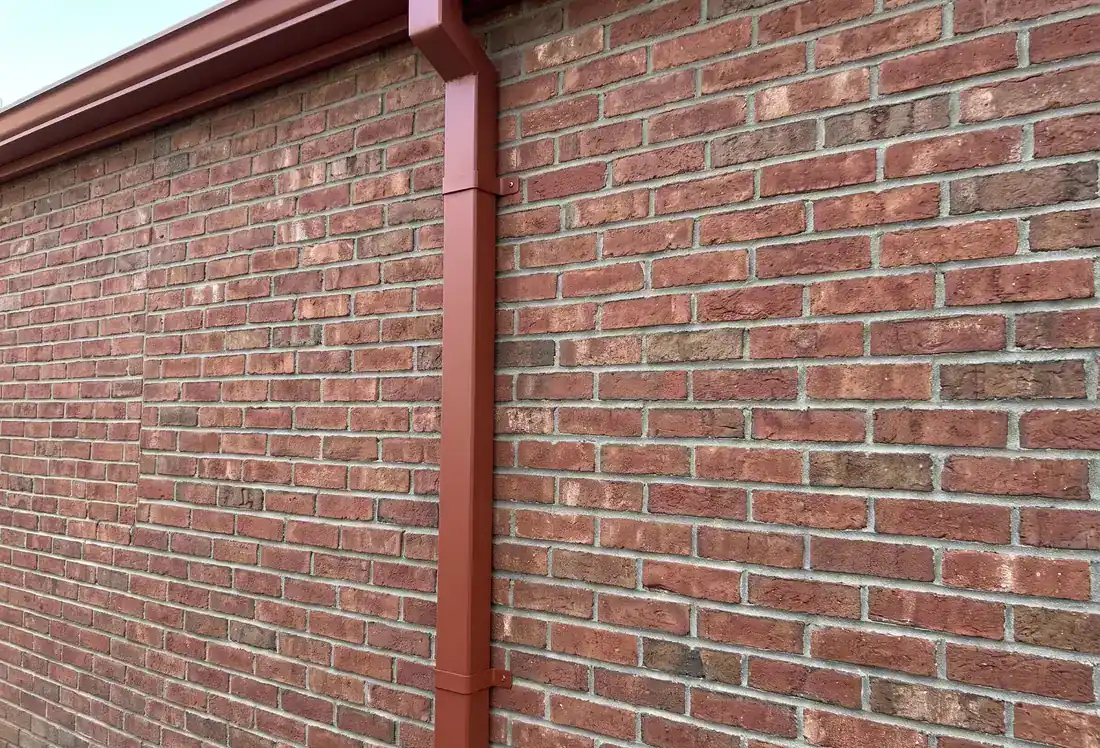
Colonial Revival houses suit crisp K-style gutters in colors matched to trim, or half-round where the cornice is simple. Bungalows often suit half-round. Whatever the profile, downspouts placed at corners and painted to match the wall keep the house looking tidy.
Historic review
As a National Register district, Brookwood appears on the city's historic districts page. The city says National Register listing does not by itself bring Historic Preservation Commission review unless a property is inside a local district boundary. Confirm your property's status with the city before major exterior changes.
Old buried drains
Many older houses had downspouts piped into underground drains. Decades on, those pipes are often blocked, broken or lead nowhere. If water bubbles up at the base of a downspout in rain, the drain has failed. Disconnecting the downspout and discharging above ground onto lawn is usually the simplest fix. On sandy soils, NC State Extension notes that sending downspouts onto vegetated areas can cut runoff volumes in half. See downspout repair.
Trees
A century of growth means big trees over many roofs. Oaks shed in spring, pines drop needles through the year, and storms bring down twigs and moss. Two cleanings a year is a minimum under heavy cover; gutter guards can reduce that.
Storms
Wilmington's 2018 rainfall of 102.40 inches, including 23.02 inches from Hurricane Florence, according to the National Weather Service, tested every old gutter in the city. Older systems with loose spikes and soft fascia are the first to fail in wind and heavy rain.
Gutter questions Brookwood owners ask
My house is about a hundred years old. What should I expect when the gutters come down?
Expect to find some fascia that needs replacing, nail holes from earlier gutter systems, and perhaps paint layers hiding soft wood. A good contractor probes the fascia and rafter tails before quoting and explains how they will price any extra wood repair, usually per foot of board replaced.
Is it worth fixing the old clay downspout drains?
Many 1920s houses sent downspouts into clay or cast-iron pipes that ran to the street or a dry well. After a century, these are often cracked, root-filled or connected to nothing. Camera inspection can confirm their state, but in sandy coastal soil, disconnecting and discharging onto lawn is usually cheaper and more reliable than repair.
Will bigger trees mean bigger gutters?
Not necessarily bigger gutters, but bigger outlets. A 3x4-inch downspout has roughly double the cross-section of a 2x3-inch one, so leaves and catkins pass through instead of jamming at the elbow. Under large oaks, larger downspouts and a fine mesh guard together solve most overflow.
A Brookwood house, roof edge to ground
| Part | What to check |
|---|---|
| Roof edge | Drip edge present, shingles not overhanging too far |
| Fascia and soffit | Paint condition, soft spots, gaps where animals can enter |
| Gutter | Profile, material, slope toward outlets, hanger spacing |
| Corners and end caps | Sealant cracks, staining below |
| Downspouts | Straps at every section, elbows clear, size |
| Discharge | Onto lawn, away from foundation and neighbors |
Common gutter jobs in Brookwood
| Common problem | Usual fix |
|---|---|
| Spikes pulling out of old fascia | Wood repair and hidden hangers |
| Downspout backing up at ground level | Test and clear or bypass the buried line |
| Gutters overflowing under big trees | Larger downspouts, guards |
| Mismatched gutters from past repairs | Full replacement in one profile |
Before you call
It helps to have a few details ready when you call about a house in Brookwood:
- Whether downspouts go into the ground
- Any rot you can see at the roof edge
- How heavily trees overhang the roof
Nearby
Neighboring areas: Carolina Place, Carolina Heights, Landfall and downtown Wilmington.